Expertly Timed, Positioned & Guided
Great Migration Kenya Safari
You're Not Chasing One Photograph — You're Witnessing an Ecosystem in Motion
Before Anything Else
The Migration is natural. It cannot be scheduled, and it cannot be guaranteed. Anyone who tells you otherwise is not being honest with you.
What is the Great Migration ?
Not an event. A year-round circuit, driven entirely by rain and grass.
Over 1.5 million wildebeest, alongside several hundred thousand zebra and gazelle, move in a continuous, roughly clockwise circuit through the Serengeti-Mara ecosystem — an area spanning northern Tanzania and southern Kenya far larger than the Masai Mara alone. There is no single starting point and no single finish. Calves are born by the hundreds of thousands on the short-grass plains of the southern Serengeti between January and March. The herds then move north and west as the plains dry, following the rain that keeps the grass growing, until by July or August the front of the herd reaches the Mara River and Kenya’s Masai Mara. They stay through the Kenyan dry season, then turn south again as the rains return further south. This is the whole picture — the Mara crossings that dominate the photographs are one dramatic chapter in a much longer story.
The Great Migration Calendar
Where the herds tend to be, month by month
These are patterns built from decades of observation, not fixed dates — rainfall shifts the calendar by weeks in either direction every year, which is exactly why local, current knowledge matters more than a printed chart.
| Period | Typical Location | What’s Happening |
|---|---|---|
| January – March | Southern Serengeti | Calving season — hundreds of thousands of calves born within weeks |
| April – May | Central & Western Serengeti | Herds moving with the long rains, dispersed across open plains |
| June | Western & Northern Serengeti | Herds consolidating, moving toward the Grumeti River |
| July – August | Northern Serengeti → Masai Mara | Mara River crossings begin as the front of the herd reaches Kenya |
| August – September | Masai Mara | Peak herd presence in Kenya, repeated crossings back and forth |
| October – November | Masai Mara → Southern Serengeti | Herds beginning the return journey south |
| December | Southern Serengeti | Short rains draw the herds back toward the calving grounds |
River Crossings, Explained Honestly
What actually determines whether you see one
A river crossing happens when the leading edge of the herd, under pressure from thousands of animals behind it, reaches the Mara, Talek or Sand River and is forced to decide whether the grazing on the other side is worth the crocodiles waiting in the water. It is not a scheduled performance. Herds can gather at a crossing point for hours, or days, before committing — or turn away entirely and cross somewhere else, or not at all that day. Positioning matters enormously: which bank of the Mara River your camp sits on, how far you are from the most active crossing points that week, and whether your guide has current information from other guides in the field, radioed in that same morning. This is the single area where local expertise has the most direct, measurable effect on what you actually see.
Great Migration Timing Matters
We help you choose your dates based on what you actually want to experience
“When should I go?” is the wrong first question. The right one is “what do I want to see?” — because the answer changes the recommended month entirely. Want the drama of a crossing specifically? Late July through September, in the Mara. Want newborn calves and the highest concentration of predators hunting them? January through March, in the southern Serengeti — not Kenya at all. Want strong wildlife viewing with genuinely fewer vehicles at every sighting? The shoulder months either side of peak season. We ask what you’re actually hoping to see before we ever recommend a date, because the honest answer is rarely “just go in August because that’s when everyone says to.”
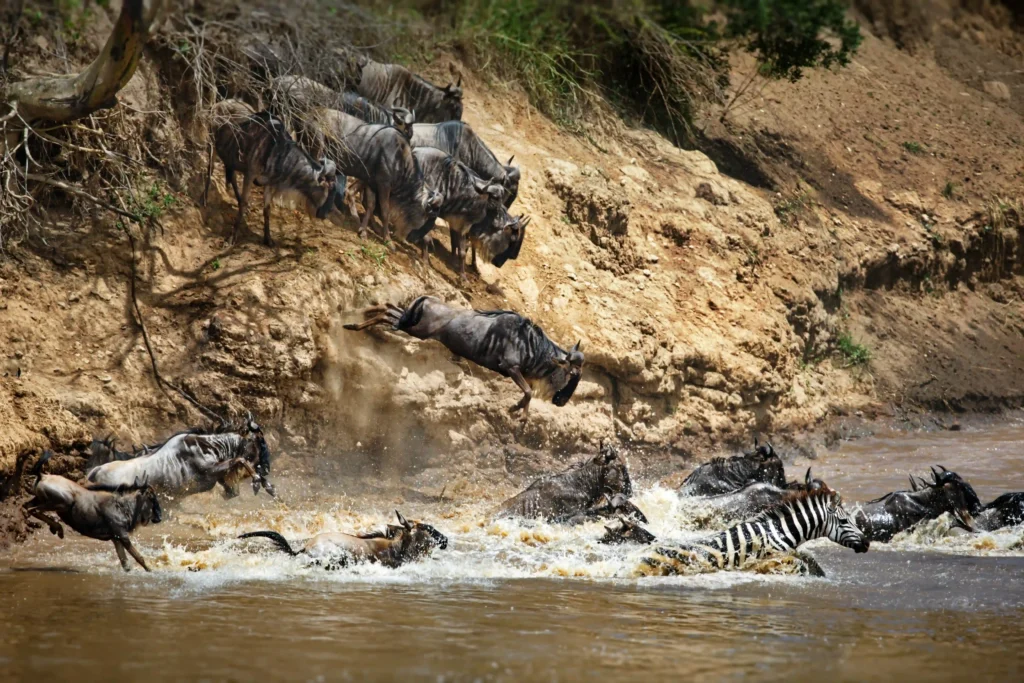
What You Might See, during Migration By Month
A realistic guide, not a promise
If You Want...
Best Timing
Newborn calves & predator action
January - March, southern Serengeti
The strongest chance of a river crossing
Late July - September, Masai Mara
Fewer vehicles, strong general wildlife
April - June, or October - November
A first Kenya safari without migration pressure
Any month — the Mara delivers year-round
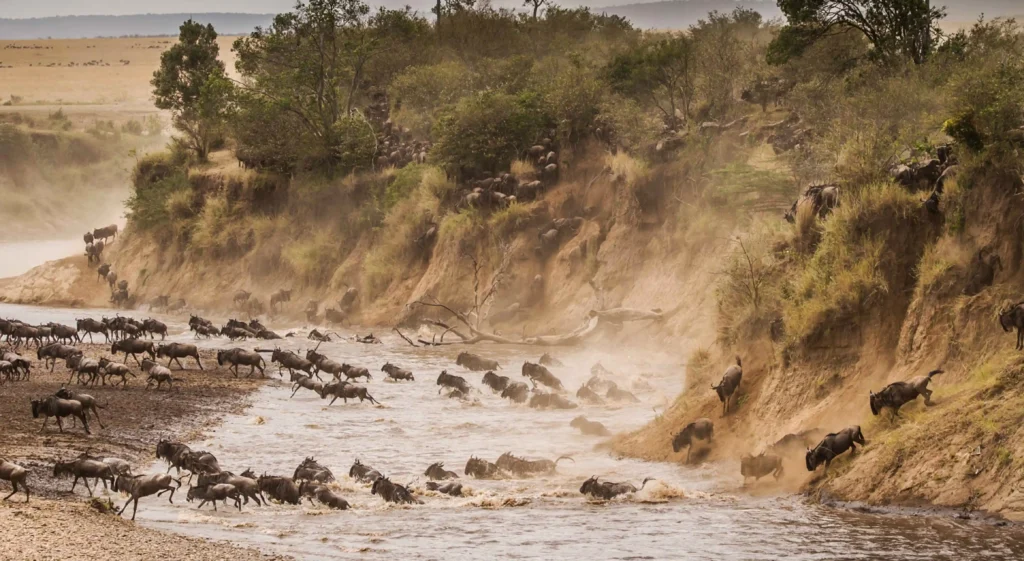
Location Matters
The right camp and conservancy can change the entire character of your safari
Two travellers can visit the Mara in the exact same week of September and have completely different trips — one crowded, shared with forty other vehicles at a single crossing point; the other quiet, private, watching the same event from a conservancy vehicle with three other guests. The difference isn’t luck. It’s which side of an invisible boundary your camp sits on, and whether the person who chose it for you actually understood what that boundary means for your specific week of travel.
Masai Mara Reserve vs Private Conservancies for Migration
Both can deliver the migration — the experience of watching it differs enormously
| Masai Mara National Reserve | Private Conservancies | |
|---|---|---|
| Crossing access | Direct access to the main crossing points | Access depends on the specific conservancy’s boundary |
| Vehicle density | Can be high at popular crossings in peak season | Capped by design, genuinely lower |
| Off-road driving | Not permitted | Often permitted, improving positioning |
| Night drives & walking | Not permitted | Often available where authorised |
| Predator activity following the herds | Excellent | Often equally excellent, with more space to watch it |
Most of our strongest migration itineraries combine both — reserve access for the crossing points themselves, and conservancy nights for the quieter, more flexible viewing of everything the migration brings with it.
Conservancies We Use for Migration Safaris
Named, specific, and chosen for a reason
Rather than trying to visit everywhere, we select destinations according to the atmosphere, wildlife and experience you want. Here is what each one actually feels like, so you can picture yourself there before we build a single day of your itinerary.
Bordering the Mara River
Mara North Conservancy
Bordering the Reserve directly along part of its most active migration corridor, Mara North supports resident wildlife year-round and gives genuine access to crossing-adjacent game viewing without the Reserve’s peak-season vehicle density
One of the Mara's highest predator densities
Naboisho Conservancy
Consistently one of the highest lion densities recorded anywhere in Kenya. During migration season, this translates directly into predator activity that follows the herds even outside the crossing points themselves — often the better sighting on a quiet afternoon.
A proven crossing-season favourite
Olare Motorogi Conservancy
Set along the Ntiakitiak River adjacent to the Reserve, this merged conservancy is consistently strong for predator sightings during migration season, with the low vehicle numbers that a shared land-use agreement with local Maasai landowners makes possible.
Choose the Right Camp during the migration safari
Proximity is not the only thing that matters — but it matters more here than almost anywhere else
Distance to Active Crossing Points
A camp thirty minutes from this week’s most active crossing beats a beautiful camp ninety minutes away.
Guide Network
Camps whose guides radio each other with real-time sightings put you in position faster than a guide working alone.
Vehicle Access Rules
Off-road driving rights change what’s actually possible when a crossing begins.
Flexibility of Schedule
A camp willing to rearrange your day around a sighting in progress, rather than a fixed activity timetable.
Reserve or Conservancy Base
Each gives a genuinely different migration experience — matched to what you told us you want to see.
Season-Specific Positioning
The right camp in July is not always the right camp in September, as the herd’s position shifts through the season.
A private vehicle, an experienced guide, and enough nights give you the ability to actually respond to what's happening — not simply hope you're in the right place at the right time.
Why Private Safari Matters More During Migration
A shared vehicle runs on a shared schedule — and the migration doesn't wait for it
On a shared itinerary, your vehicle leaves when the group’s plan says to leave, returns when the group’s plan says to return, and moves on to the next activity regardless of what’s building at a crossing point a few kilometres away. A private vehicle can simply stay. If your guide hears over the radio that wildebeest are gathering at a crossing forty minutes away, a private safari can go, wait, and watch — for as long as it actually takes, which is sometimes twenty minutes and sometimes three hours. This single difference is, in our experience, the most decisive factor in whether a migration trip delivers the moment travellers came for.
How Many Nights Do You Need for the migration safari?
More nights doesn't guarantee a crossing — but it genuinely improves your realistic odds
Nights in the Mara
What It Means for Your Odds
2 Nights
3 game drives — a real chance, but a narrow window if conditions don't cooperate
3 Nights
5 game drives — our minimum recommendation during peak crossing season
4+ Nights
6-7 game drives — genuine weather and timing insurance, and time to follow the herd's actual movement that week
In peak season we recommend at least three nights in the Masai Mara. Two nights leave one full day and are a gamble.
Choose the Right Safari Style
Migration-focused doesn't mean the same trip for everyone
Pure Migration Focus
Maximum nights in the Mara during peak season, minimal time elsewhere — for travellers whose priority is singular.
Migration + Wider Kenya
A shorter Mara stay combined with Amboseli or Laikipia, for a fuller sense of the country alongside the migration.
Photography-Focused
Vehicle configuration, guide selection and pacing built specifically around capturing the crossing, not just seeing it.
Calving Season Safari
The Serengeti side. From about January to March the herds calve on the southern Serengeti plains in Tanzania. If calving is your priority, the Tanzanian side is where to be at that time. From July to October the herds are in the Kenyan Masai Mara. We can plan a Kenya-only safari for those months, or combine the two countries
Family Migration Safari
Paced around children’s stamina, with realistic expectations set from the outset.
Migration + Beach
The drama of the herds followed by several unhurried days on the Indian Ocean coast.
Remember...
You are travelling to experience an ecosystem, not to chase one photograph.
A crossing is a single dramatic hour. The migration itself is a season — and the season has far more to offer than that hour alone.
Beyond the Crossing — What Else the Migration Season Offers
The story that isn't in most people's photographs
Predator Density
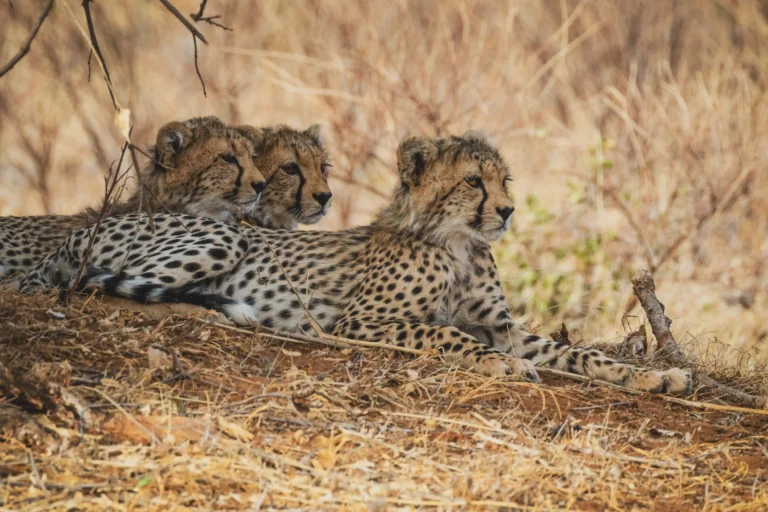
Lion, cheetah and hyena populations concentrate wherever the herds are, producing some of the best general predator viewing of the entire year.
The Sound of a Million Animals
A grunting, moving herd stretching to the horizon is an experience in itself, crossing or not.
Calving Season Drama
In the southern Serengeti, newborn calves and the predators that follow them offer a completely different, equally compelling story.
Resident Wildlife
Elephant, giraffe, resident lion prides and the Mara’s other permanent residents don’t leave when the migration arrives — they share the stage.
Landscape & Light
The Mara’s golden grass and dramatic skies during migration season are their own reason to be there, camera or not.
The Ecosystem's Scale
Understanding how rain, grass and a million grazing animals connect across two countries is, for many travellers, more memorable than any single sighting.
Great Migration safari packages
Six starting points, each built around a genuine migration objective
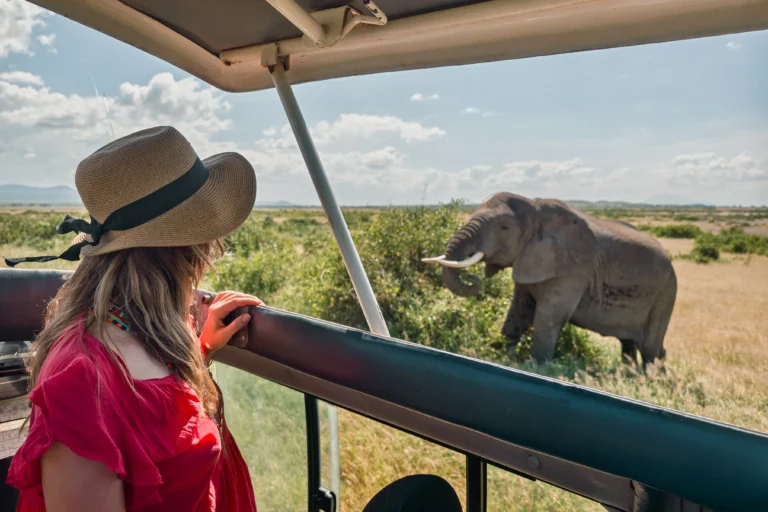
2 Nights
3-Day Masai Mara Safari
Nairobi → Masai Mara → Nairobi
Why choose this safari
Choose this when time is short: two nights in the Mara, enough for a first look at the big cats and, from July to October, the herds.
Big cats · Open savannah · Short break
Schedule between July and October if seeing the herds matters; river crossings cannot be guaranteed.
From $1,850
per person*

3 Nights
4-Day Classic Masai Mara Safari
Nairobi → Masai Mara → Nairobi
Why choose this safari
Choose this when you want a real first safari in one destination: three nights, no camp changes and more than one full day at the river in season.
Big cats · River country · No camp changes
July to October gives the best chance of the herds; crossings are never guaranteed.
From $2,250
per person*
4 Nights
5-Day Masai Mara Conservancy Safari
Nairobi → Masai Mara conservancy → Nairobi
Why choose this safari
Choose this when you want fewer vehicles at each sighting, with night drives and walking safaris where the conservancy permits.
Fewer vehicles · Night drives · Walking safaris
Conservancy and camp to be confirmed. Herds move in and out of the conservancies, July to October.
From $5,650
per person*

6 Nights
7-Day Great Migration Safari: Masai Mara
Nairobi → Masai Mara → Nairobi
Why choose this safari
Choose this when the river crossings are the reason you are travelling: six nights in one place gives you several days at the Mara River rather than a single attempt.
River crossings · Full-day drives · Big cats
Best timed July to October, with peak herd presence in August and September.
From $4,200
per person*
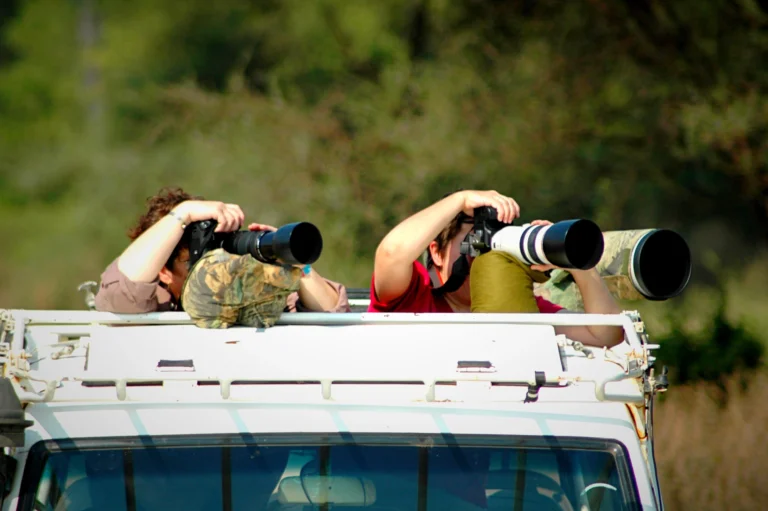
6 Nights
7-Day Masai Mara Conservancy Photography Safari
Nairobi → Mara conservancy (6 nights) → Nairobi
Why choose this safari
Choose this when you want migration-season images without crowds: one conservancy, flexible hours and a vehicle set up for photography.
Low-density viewing · Flexible hours · Predator action
Herds move in and out of the conservancies; July to October gives the added possibility of herds.
From $7,500
per person*
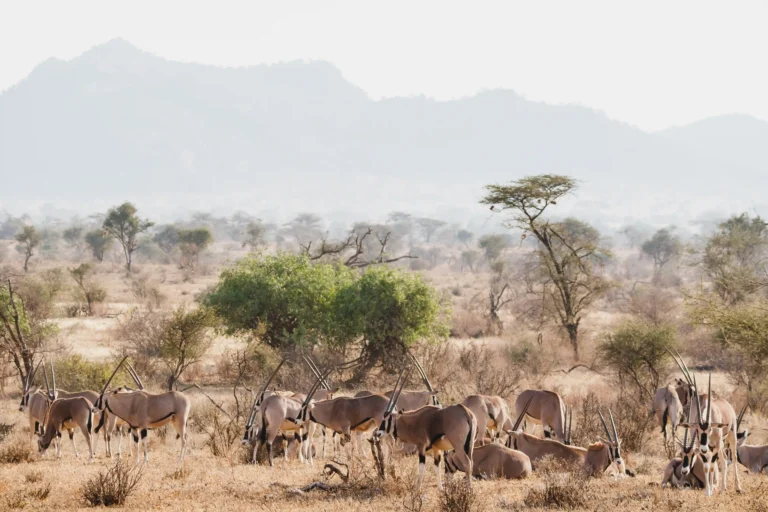
9 Nights
10-Day Grand Kenya Fly-In Safari
Nairobi → Samburu → Amboseli → Masai Mara → Nairobi
Why choose this safari
Choose this when you want the migration as the finale of a wider Kenya: Samburu’s northern species and Amboseli’s elephants first, the Mara in season last.
Northern species · Elephants · Mara herds
Fly-in between regions; pack soft bags for light-aircraft luggage limits.
From $8,000
per person*
What We Can and Cannot Promise
Said plainly, because it's the most important paragraph on this page
We cannot promise a river crossing on a specific day
No operator honestly can. Anyone who guarantees this is making a claim they cannot control.
We cannot promise the herd will be in a specific location on your exact dates
Rainfall shifts the calendar every year, sometimes by weeks.
We can promise expert positioning, based on current, real information
Not a printed chart from five years ago, but what’s actually happening in the ecosystem this season.
We can promise enough nights to give you a genuine, realistic chance
Rather than a shorter itinerary that looks better on paper and worse in the field.
We can promise a private vehicle able to respond the moment something happens
Not a shared schedule that moves on regardless.
We can promise an experience worth taking even without a crossing
Because the ecosystem, not the photograph, was always the actual point.
Photographing the Migration
The right position matters more than the right lens
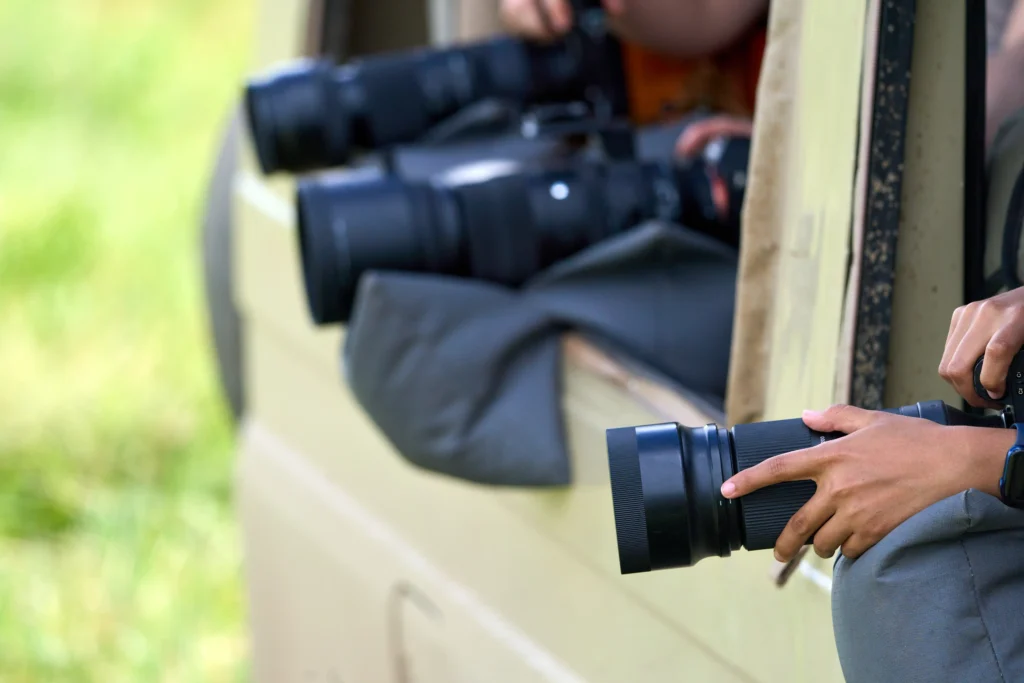
Vehicle positioning relative to the sun, distance from the crossing point without disturbing it, patience to wait rather than move on too soon, and a guide who understands photographic composition as well as animal behaviour — these determine a migration photograph far more than camera equipment does. We build dedicated time into photography-focused itineraries specifically for this, rather than treating a crossing as a five-minute stop on a longer game drive.
Migration + Beach
The adrenaline of the herd, then an ocean that asks nothing of you at all
A migration safari is intense by design — early starts, long waits, sudden bursts of activity. Extending the trip with several days at Diani afterward gives the experience somewhere to land, rather than ending abruptly on a flight home.
Cost of a Kenya Migration Safari
What actually moves the price during migration season
Season
July-October carries the highest camp rates of the year, driven by demand.
Number of Nights
More nights means a genuinely better realistic chance, at a genuinely higher cost.
Reserve or Conservancy
Conservancy stays often carry additional conservation fees layered onto the room rate.
Camp Category
The single largest cost variable, independent of seaso
Private Vehicle
Standard on every itinerary we build, priced into the per-person rate.
Booking Time
Peak-season migration camps are genuinely limited — early booking protects both availability and rate.
When Not to Chase the Migration
Honest advice, even when it costs us a booking
If your travel dates are fixed and fall outside the July-October window, and you can’t move them, we will tell you that directly rather than sell you a Mara safari timed to miss the main event. The Mara delivers exceptional wildlife viewing year-round — Big Five, resident predators, extraordinary landscapes — with or without the migration passing through. For some travellers, a quieter month with genuinely lower rates and far fewer vehicles is the better trip, migration or not. We’d rather have that conversation honestly upfront than let a wrong expectation surface on day three of your safari.
Why This Migration Safari Rewards Real Expertise
Twenty-two years of watching this ecosystem move
Migration safaris fail for one of two reasons: a generic booking that ignores where the herd genuinely is that week, or an itinerary too short and too rigid to respond when something happens. Both are avoidable, and both are exactly the problem this kind of experience is built to solve.
1
Tell Us What You Want to See
A crossing specifically, general wildlife density, calving season, or something else entirely.
2
We Check Current Herd Position
Real, current information from guides in the field, not a static calendar.
3
We Recommend Genuine Dates
Matched honestly to what you told us, even if that means a different month than you first assumed.
4
We Select the Right Location
Reserve, conservancy, or a considered combination of both.
5
We Choose the Right Camp
Positioned for this season’s herd movement specifically, not a generic Mara camp.
6
We Build in Enough Nights
A realistic chance, not a shortened itinerary that looks better on paper.
7
You Travel With a Private Vehicle and Guid
Able to respond the moment something happens, for as long as it takes.
Plan Your Great Migration Kenya Safari
Tell us what you want to witness, and we'll tell you honestly how to get there
Share your travel dates or flexibility, group size and what draws you to the migration specifically, and we’ll return honest guidance alongside an itemised proposal within 12 hours.
Frequently Asked Questions
Great Migration Kenya safari — common questions, answered directly
The continuous, year-round movement of over 1.5 million wildebeest and zebra through the Serengeti-Mara ecosystem, driven by rainfall and grass availability.
No, it moves through both Kenya and Tanzania throughout the year; the Masai Mara sees the herds typically from July to October.
No, and any operator promising a guaranteed crossing is not being honest — it is a natural event that cannot be scheduled.
Late July through September typically offers the strongest chance of river crossings in the Masai Mara.
Typically January to March, in the southern Serengeti, not the Masai Mara.
Not exactly bad, but outside July-October the main herds are usually elsewhere in the ecosystem; the Mara still offers excellent year-round wildlife viewing.
Both have a role — the Reserve offers direct access to major crossing points, while conservancies offer lower vehicle density and more flexible viewing rules.
As close as genuinely possible during peak crossing season — proximity directly affects how quickly you can reach an active crossing.
Mara North, Naboisho and Olare Motorogi are among the strongest, each offering slightly different access and predator activity.
A minimum of 3 nights in the Mara during peak season is recommended; 4 or more nights meaningfully improves your realistic odds.
A private vehicle can respond immediately to a developing crossing and stay as long as needed, unlike a shared vehicle on a fixed schedule.
Yes, Amboseli, Laikipia and a Diani beach extension are all popular combinations.
Migration-season rates run higher than shoulder-season pricing; cost depends on camp category, nights and location, quoted per itinerary.
Ideally 9-12 months ahead for peak season, given genuine camp availability constraints.
The Mara offers exceptional wildlife viewing regardless — predators, resident herds and landscape make the trip worthwhile independent of any single event.