Family Safari Guide
Family Safari Kenya
A private Kenya safari designed around your family — your children’s ages, energy levels, interests and travel style. Whether you’re travelling with toddlers, teenagers, grandparents or several generations together, this is everything a parent needs to plan with confidence.
Private Kenya Safaris Designed for the Whole Family
More than a holiday — a shared discovery
A Kenya family safari is an opportunity to discover wildlife together, experience extraordinary landscapes, learn about conservation and different cultures, and create memories that stay with your family long after you return home. From watching elephants against Mount Kilimanjaro in Amboseli to following lions across the Masai Mara, Kenya offers an extraordinary combination of wildlife, adventure, education, nature and comfortable accommodation — all within a relatively compact, easy-to-navigate country.
But a successful family safari isn’t simply about choosing a destination. It’s about designing the right pace, the right camps, the right vehicle, the right experiences and the right itinerary for your specific family. Kenya’s tourism authorities actively position the country as welcoming to family and multigenerational travel, and the variety on offer backs that up: open savannahs, mountains, forests, lakes, private conservancies, national parks, traditional communities and the Indian Ocean coast, all combinable within one trip. A safari doesn’t have to mean spending every day in a vehicle looking for animals — a well-designed itinerary can blend Big Five wildlife, rhino conservation, nature walks, cultural experiences, photography, junior conservation activities, swimming, bush breakfasts, stargazing, horseback experiences where appropriate, and relaxing days beside the ocean, so that children, parents and grandparents can all participate at their own pace.
Is Kenya a Good Family Safari Destination?
Yes — but the answer depends on how the safari is designed
There is no single family safari that works for every family. A safari for parents travelling with a three-year-old should be planned very differently from one for a family with teenagers, and a multigenerational trip with grandparents needs a different structure again. The factors that actually matter: children’s ages, travel season, destination, accommodation, private or shared vehicle, driving distances, length of game drives, camp rules, available family accommodation, medical and travel considerations, children’s interests, amount of downtime, and your family’s preferred level of comfort.
Camp minimum-age policies also matter more than most parents expect, and they can differ between properties belonging to the same group. Kicheche, for example, currently sets a minimum age of seven at some of its camps, while offering age-specific family activities at selected properties — so the brand name alone tells you very little; the specific camp and its current policy is what matters. We verify this for every family itinerary we design.
The objective is simple: build the safari around the family — not make the family fit into a standard safari.
Family Safari by Children's Age
There is no universal "correct" age — only what suits your child
The best age depends on your child’s personality, the destination, the accommodation and the pace of the trip. Here’s what actually changes at each stage.
0–2 years
Babies & Toddlers
Travelling with very young children requires additional planning, focused on shorter transfers, comfortable accommodation, flexible schedules, a private vehicle, easy access to medical facilities where possible, family rooms or private houses, flexible meal times, sufficient downtime and carefully chosen activities. At this age, the safari may be more about experiencing nature together than completing long game drives — and malaria prevention needs paediatric-specific advice well before you travel. Always check individual camp age policies before booking; some set no minimum, others do.
4–7 years
Curious & Engaged
Children in this range can become genuinely fascinated by wildlife when the experience is presented well. Rather than simply driving around looking for animals, build in animal identification, birdwatching, tracking footprints, learning about animal behaviour, short guided nature experiences where permitted, cultural experiences, swimming, bush breakfasts, simple conservation activities and storytelling around the campfire. Game drives should be balanced with breaks — the goal is exciting, not exhausting.
8–12 years
Ready to Go Deeper
This can be an excellent age for a family safari. Children can engage more deeply with wildlife identification, photography, animal tracking, conservation, geography, ecosystems, birding, cultural experiences, nature walks where permitted, and longer game drives. Some camps offer dedicated children’s programmes — Kicheche, for example, currently offers supervised activities for children aged 6–14 at selected camps, including tracking, camp walks, cultural activities and nature-based learning.
13–17 years
Teenagers
Teenagers can often appreciate a more adventurous and immersive safari: wildlife photography, conservation experiences, walking safaris where permitted, horseback safari where appropriate, cultural experiences, tracking, birding, longer game drives, wilderness experiences, beach activities, diving or snorkelling where appropriate, and more remote destinations. Older children can also be involved in planning the safari itself — giving teenagers a choice of activities turns them from passengers into participants.
All generations
Multigenerational Safaris
Bringing grandparents, parents and children together requires careful planning, since different generations often have different energy levels and interests. We look for private vehicles, private accommodation, easy access, shorter transfer times, comfortable camps, flexible meal times, suitable room configurations, different activity options, sufficient rest and reliable logistics. Private safari houses are particularly useful here, since they let the whole group stay together while keeping real flexibility for each generation’s pace.
The Best Family Safari Destinations in Kenya
There is no single best destination — each region offers something different
First-time family safari
Masai Mara
Extraordinary wildlife density — lions, leopards, cheetahs, elephants, buffalo, giraffes, zebras, hippos, crocodiles, wildebeest, hyenas and hundreds of bird species — plus private conservancies, family-friendly camps, cultural experiences, photography, balloon safari options and excellent safari-and-beach combinations. We often consider both the National Reserve and the surrounding conservancies, since a conservancy offers a different, more private style of safari.
Conservation, active families
Laikipia
Wildlife, rhino conservation, walking, horseback experiences, community conservation, private conservancies and dramatic landscapes — for families wanting something more immersive than traditional game drives, where children can learn about conservation in a tangible rather than theoretical way.
Elephants & Kilimanjaro
Amboseli
One of Kenya’s most recognisable landscapes — large elephant herds, giraffes, zebras, wildebeest, buffalo, birds, Maasai culture and spectacular Kilimanjaro views. Combines naturally with the Masai Mara for a strong contrast in landscape and wildlife.
Older children, culture
Samburu
A drier, more rugged landscape with mountains, rocky terrain and riverine ecosystems, home to elephants, lions, leopards, giraffes, Grevy’s zebra, gerenuk, reticulated giraffe, Somali ostrich and oryx, alongside meaningful Samburu cultural experiences — good added variety for older children and teenagers on a longer itinerary.
Wilderness & beach combination
Tsavo
Vast, rugged and remote, home to elephants, lions, buffalo, giraffes, zebras, hippos, crocodiles, volcanic landscapes, forests and waterholes — strategically useful for combining safari with the coast (Nairobi → Tsavo → Diani, or Masai Mara → Tsavo → Diani).
Relaxed stopover
Lake Naivasha
Works particularly well between Nairobi and the Masai Mara — boat experiences, birdwatching, nature walks, wildlife viewing, lake scenery and, in appropriate areas, cycling, giving families a useful change of pace mid-safari.
Rhino & birdlife
Lake Nakuru
Can complement a Mara itinerary well — rhino, buffalo, giraffe, lions, leopards and flamingos or other birdlife depending on conditions, adding wildlife diversity without a major detour.
Limited time
Nairobi National Park
Particularly useful at the start or end of a trip — wildlife without travelling long distances from the capital, and a good option if the family has only a few days.
Quieter, less conventional
Meru
A more remote safari environment, well suited to families wanting a less-visited destination as part of a longer northern Kenya itinerary.
| Destination | Best For | Family Appeal |
|---|---|---|
| Masai Mara | First safari, Big Five | ★★★★★ |
| Laikipia | Conservation, active families | ★★★★★ |
| Amboseli | Elephants & Kilimanjaro | ★★★★★ |
| Samburu | Older children & culture | ★★★★ |
| Tsavo | Wilderness & beach combination | ★★★★ |
| Lake Naivasha | Relaxed stopover | ★★★★ |
| Lake Nakuru | Rhino & wildlife | ★★★★ |
| Nairobi National Park | Short safari | ★★★★ |
| Meru | Remote safari | ★★★ |
The right choice depends on your children’s ages, interests, available time and desired level of comfort — tell us these and we’ll narrow it down.
Best Family-Friendly Camps & Lodges in Kenya
A beautiful lodge is not automatically a good family lodge
We look at suitable room configurations, family tents, private houses, child policies, age restrictions, flexible dining, swimming pools where appropriate, children’s activities, suitable guides, private vehicles, proximity to wildlife, manageable transfers and appropriate safety arrangements — not just the property’s marketing.
Talek River, Masai Mara
JW Marriott Masai Mara Lodge
24 tented suites including a two-tent family suite, private outdoor Jacuzzis, and a spa, gym and photo studio — a genuine safari environment with international hotel-standard consistency.
Borana Conservancy, Laikipia
Sirai House
A private safari house built around exclusivity and personalised family experiences, including horseback safari and rhino tracking with Borana’s own scout team.
Watamu, Coast
Hemingways Watamu
Ocean rooms and larger ocean residences including multi-bedroom accommodation, directly on the Watamu coastline — the natural finish to a family safari.
Family Policies by Brand
Saruni Basecamp
Several family-oriented options across the Mara and northern Kenya, with distinct children’s rates and set age limits for activities such as walking safaris and mobile camping — confirm per property.
Kicheche
A family programme built around age-appropriate activities — nature walks, tracking, plant identification, cultural experiences, bush skills and junior ranger experiences. Family suites accommodate up to five guests, with exclusive use of a safari vehicle available; minimum ages vary by camp, so we verify the specific property first.
Elewana Collection
Several properties suit families well — Tortilis Camp Amboseli, Elsa’s Kopje Meru, Lewa Safari Camp, Kifaru House, the Loisaba properties, Sand River and Elephant Pepper Camp. Lewa Safari Camp, for example, currently has dedicated family tents with connected en-suite accommodation for a family of five.
Hemingways Collection
Hemingways River Camp Mara currently lists a dedicated Family Safari Suite, with its 2026 policy specifying different accommodation rules by children’s age and room category — a reminder that the property name alone never tells you whether it suits your family; the actual accommodation and child policy does.
Depending on your itinerary, we can also consider Bush & Beyond, Soroi, Great Plains Conservation, Wilderness, JW Marriott, Sirai, Wilder Group, Angama, Basecamp, and selected private safari houses and conservancy camps — for each, we assess age policy, accommodation, activities, vehicle arrangements, location, dining and logistics before recommending it.
Family Safari Accommodation Types
Choose accommodation for the family, not just the destination
| Type | What It Offers |
|---|---|
| Family Tents | Two connected sleeping areas, letting parents and children stay close while keeping some privacy. |
| Family Suites | A single larger unit, useful for families needing more shared space. |
| Private Safari Houses | Exclusive-use accommodation with private staff, guide and vehicle, flexible meals and schedules — excellent for multigenerational groups and celebrations. |
| Interconnecting Rooms | Two separate rooms joined by a shared door, where the property offers them. |
| Villas | Particularly useful for larger families or multi-family groups travelling together. |
Private vs Shared Safari Vehicle for Families
One of the best investments most families can make
| Shared Vehicle | Private Vehicle | |
|---|---|---|
| Cost | Lower | Higher, but often worth it for families |
| Schedule | Follows another group’s timing | Leave and return whenever suits your children |
| Sightings | Leave/stay according to group consensus | Spend as long as you like at an interesting sighting |
| Flexibility | Fixed activities and meal times | Shorten drives, take breaks, adjust pace freely |
| Focus | Shared commentary for the whole group | Guide focuses entirely on your children’s interests |
A shared vehicle can work for budget-conscious families with older children comfortable with a fixed schedule — but for families with younger children especially, we generally favour a private vehicle wherever the budget allows.
A shared vehicle can work for budget-conscious families with older children comfortable with a fixed schedule — but for families with younger children especially, we generally favour a private vehicle wherever the budget allows.
Family Safari Experiences
More than a sequence of game drives
Wildlife Game Drives
The foundation of most safaris — a skilled guide turns this into a lesson in animal identification, behaviour, tracks, predator-prey relationships, ecosystems and conservation, not just a checklist of sightings.
Junior Conservation Experiences
Where available, children learn about endangered species, anti-poaching work, habitat protection and wildlife monitoring. Kicheche’s current Laikipia family activities include an Ol Pejeta anti-poaching dog experience for ages 12 and above, and visits to the Morani Information Centre.
Maasai & Samburu Cultural Experiences
The best cultural experiences go beyond a village visit — traditional lifestyles, livestock, crafts, food, music, stories and the relationship between communities and wildlife, delivered respectfully and led locally.
Nature Walks
Walking changes how a child sees the wilderness — insects, tracks, plants, birds and animal signs replace the search for large animals alone. Availability and minimum ages vary by destination and property.
Wildlife Photography
Give children their own challenge: photograph five different mammals, three birds, an animal footprint, a landscape, a sunrise, Mount Kilimanjaro, or a family wildlife portrait. Older children and teenagers especially engage with this.
Bird Watching
Kenya rewards young birders with colour, calls, nests, feeding behaviour and migration to notice — and gives the family something absorbing to do between major sightings.
Bush Breakfast & Bush Dinner
A meal in the wilderness, or an outdoor dinner arranged depending on location, weather and safety conditions, often becomes a family’s most memorable single moment of the trip.
Sundowners & Stargazing
Watching the landscape change as the sun sets provides a natural pause after a drive; away from city lights, camps offer an excellent introduction to the night sky for children.
Swimming & Downtime
Not every hour should be educational — swim, read, rest, play. This matters more for younger children than parents often plan for.
Horseback Safari
Offered at selected properties and conservancies, chosen according to age, riding experience, safety requirements, camp policy and destination.
David Sheldrick Wildlife Trust
A visit to see orphaned elephant calves being hand-raised — a genuinely moving, age-appropriate introduction to conservation for children of almost any age.
Giraffe Centre
Hand-feeding endangered Rothschild’s giraffe at eye level — a highlight for younger children especially, and a good first-day activity to ease into the trip.
How to Keep Children Engaged During the Safari
A safari becomes memorable when children are active participants
Create a wildlife checklist
Lion, elephant, giraffe, zebra, buffalo, rhino, hippo, cheetah, leopard, ostrich, crocodile — ticking off sightings turns passive watching into an active game.
Make photography a game
Find the best animal portrait, photograph five different species, capture unusual behaviour, or photograph a landscape — a simple challenge with a clear goal.
Teach tracking
What animal made this footprint? Which direction was it moving? What might it have been doing? What other signs can we see?
Learn animal behaviour, not just names
Instead of “there’s a lion,” ask what it’s doing — resting, hunting, watching, calling, moving, interacting with another animal. This turns viewing into observation and discovery.
Encourage questions
A good guide adapts explanations to a child’s age — encourage your children to ask rather than just watch.
Give children responsibility
Older children can keep a safari journal — animals seen, birds identified, interesting facts, favourite sightings, photographs and questions of their own.
Keep drives shorter and more frequent for younger children
Two shorter drives with a break at camp in between generally holds attention better than one long, uninterrupted outing.
Give them their own binoculars and a job
A child with their own binoculars and the task of “spotting” a specific animal stays engaged far longer than one simply told to watch.
Involve them in the planning beforehand
Letting a child choose which animal they most want to see, or pick one activity themselves, builds real anticipation before you even leave home.
Tell your guide their interests directly
A good guide will tailor commentary — insects and tracks for a curious younger child, predator behaviour and conservation detail for an older one — but only if briefed in advance.
Family Safari & Beach
Safari → Beach → Home
After several days of early mornings and wildlife viewing, children often appreciate swimming, snorkelling, beach time, paddleboarding, boat trips, marine life, relaxed meals and genuine downtime. One of our preferred family formats gives children the excitement of wildlife followed by several days of relaxation, with the final choice depending on flight connections, available time, budget and preferred accommodation.
Classic
Nairobi → Masai Mara → Diani
The most popular family combination — Big Five wildlife followed by white-sand relaxation.
Extended
Nairobi → Amboseli → Masai Mara → Watamu
Two safari ecosystems plus a quieter, more family-oriented coastal finish.
Conservation-led
Nairobi → Laikipia → Masai Mara → Kilifi
Rhino conservation and walking in Laikipia, classic Mara wildlife, then a private coastal finish.
Wilderness route
Nairobi → Amboseli →Diani
Rhino conservation and walking in Laikipia, classic Mara wildlife, then a private coastal finish.
How Many Days Do You Need, and Sample Itineraries
The longer the trip, the more it matters to build in rest days
| Duration | What It Suits |
|---|---|
| 4 days | Enough for a focused Masai Mara safari, or as one leg of a longer trip. |
| 5–6 days | A good introduction to Kenya, or two ecosystems (e.g. Amboseli + Masai Mara) without rushing. |
| 7–8 days | Two or three destinations without making every day a transfer day. |
| 10 days | Excellent for safari plus beach. |
| 12–14 days | A comprehensive family journey, or a multigenerational trip with longer stays throughout. |
4-Day First Family Safari
Nairobi → Masai Mara → Nairobi — first-time families, limited time, younger children
5-Day Family Safari
Nairobi → Masai Mara → Nairobi — enough time to settle into a relaxed rhythm
6-Day Kenya Family Safari
Nairobi → Amboseli → Masai Mara → Nairobi — elephants, Kilimanjaro, classic savannah
7-Day Family Wildlife Safari
Nairobi → Laikipia → Masai Mara — conservation, private conservancy experiences, Big Five
8-Day Family Kenya Safari
Nairobi → Amboseli → Laikipia → Masai Mara — several ecosystems without rushing
10-Day Family Safari & Beach
Nairobi → Masai Mara → Tsavo → Diani — classic safari, wilderness, Indian Ocean
12-Day Family Kenya Adventure
Nairobi → Samburu → Laikipia → Masai Mara → Diani — greater variety for older children and teens
14-Day Multigenerational Kenya Safari
Nairobi → Samburu → Laikipia → Masai Mara → Diani — longer stays, private vehicle throughout, comfort-led pace
These are starting points, not fixed packages. See our full Family Safari Kenya Packages for pre-built options with indicative pricing, or tell us your children’s ages and we’ll design one specifically around your family.
A Typical Day on a Family Safari
No rigid schedule — a rhythm that adjusts to your family
Early morning
Wake up, breakfast.
Morning
Game drive, while wildlife is most active.
Midday
Return to camp, lunch, swimming, rest.
Afternoon
Optional activity, or simply more relaxation.
Late afternoon
Second game drive.
Sunset
Sundowner, where appropriate.
Evening
Dinner, storytelling, stargazing, rest.
Family Safari Meals & Dietary Requirements
Unfamiliar food is a real, common worry — and an easy one to solve in advance
When selecting camps, we consider children’s meals, dietary requirements, flexible meal times, packed lunches, early dinners, allergies and familiar foods. Policies vary by property — Elewana, for example, highlights flexible mealtimes at its boutique properties. Tell us about vegetarian, vegan, allergy, gluten-free, lactose-intolerant, religious dietary requirements or simple children’s preferences before travel; advance notice makes it far easier for a camp kitchen to prepare properly rather than improvise on arrival.
When Is the Best Time for a Family Safari?
Kenya can be visited year-round — the season shapes the experience
| Period | What to Expect |
|---|---|
| January–February | Often a strong period for both wildlife viewing and family travel. |
| March | A transitional period with changing weather. |
| April–May | Wetter, greener landscapes and, at some properties, lower rates — consider road conditions and the type of experience you prefer. |
| June | Transition toward the busier safari season. |
| July–October | Peak safari season, particularly for the Great Migration — demand and rates are higher, and advance booking matters. |
| November | Transitional, with renewed greenery in many areas. |
| December | A popular family holiday period, especially around Christmas and New Year — plan well ahead for the best camps. |
For families travelling during Easter, July/August, October half-term, Christmas or New Year, book well in advance — the most desirable family suites and private-use properties are genuinely limited during these windows. If your dates fall between roughly July and October, the Masai Mara may offer a chance to witness the Great Migration, though this is a natural event, not a scheduled performance — sightings and river crossings can’t be guaranteed on a particular day, and the Mara’s value extends well beyond the migration itself.
Fly or Drive Between Destinations?
Both have a place — the right choice depends on the route
Flying reduces travel time and makes a multi-destination safari far more comfortable — particularly valuable for families with young children, longer distances, luxury itineraries or shorter holidays. Driving offers scenic value, flexibility and a better feel for the Kenyan landscape, and can work well on shorter, more direct routes. Nairobi is the natural starting point for most family safaris, with connections through Jomo Kenyatta International Airport to the Masai Mara, Amboseli, Samburu, Laikipia, Tsavo, Naivasha and Nakuru. For families arriving after a long international flight, we generally recommend building in a rest day before starting an intensive safari, rather than heading straight into the bush exhausted.
Family Safari Cost in Kenya
There is no single price — compare the complete package, not the nightly rate alone
Total cost depends on number of travellers, children’s ages, season, accommodation, room configuration, private vehicle, flights, road transfers, park fees, conservancy fees, activities, any beach extension, and trip duration.
VALUE-CONSCIOUS
Fewer destinations, comfortable camps, good-value properties, efficient routing, shared or private vehicle depending on priorities.
LUXURY
Premium camps, private vehicle, domestic flights between regions, family suites, more private experiences.
ULTRA-LUXURY
Private-use properties, exclusive camps, private aircraft or charter where appropriate, dedicated staff, highly personalised experiences.
Family Safari, Conservation & Community
One of the greatest educational opportunities of the trip
Children can learn that wildlife conservation involves protected areas, communities, rangers, landowners, tourism, research, habitat protection and education — turning a family safari into far more than wildlife viewing, and helping children understand how people and wildlife genuinely share landscapes. Kenya’s safari industry is closely connected with the communities living around its wildlife areas, and responsible cultural experiences can help children understand different lifestyles, traditional knowledge, crafts, livestock, local history and conservation relationships. We prioritise experiences that are respectful and meaningful, not ones that treat communities as an attraction. This same educational value extends to photography and general wildlife learning — instead of reading about ecosystems in a textbook, children observe predator and herbivore behaviour, food chains, migration, adaptation, habitats, conservation and biodiversity directly, with a guide able to adapt the explanation to each child’s age.
How We Design a Family Safari
We don't start with a standard package — we start with your family
1
Understand Your Family
Children’s ages, number of adults, grandparents, interests, previous safari experience, preferred accommodation, budget and travel dates.
2
Choose the Right Destinations
We assess wildlife, road distances, flights, camp location, available activities, season and family logistics — a family with toddlers needs a different route from one with teenagers.
3
Select the Right Camps
Child policy, family rooms, private houses, pools, activities, meal flexibility, guide quality and vehicle arrangements.
4
Select the Right Camps
Fewer destinations, longer stays, better experiences — rather than many destinations, constant packing and long transfers.
5
Build Age-Appropriate Experiences
Young children need genuinely different activities from teenagers, and we design each itinerary accordingly.
6
Build in Downtime
Swimming, reading, relaxing, family meals and room for spontaneous wildlife encounters — a family safari shouldn’t feel like a military schedule.
7
Add the Beach Where Appropriate
If time allows, a coastal extension provides the perfect conclusion.
8
Review the Logistics
Flights, transfers, vehicles, room configuration, child policies, activity age limits, meal arrangements, travel documents, insurance and seasonal considerations — confirmed before your itinerary is finalised.
Before You Book: What to Ask and Check
What Makes a Good Family Safari Guide
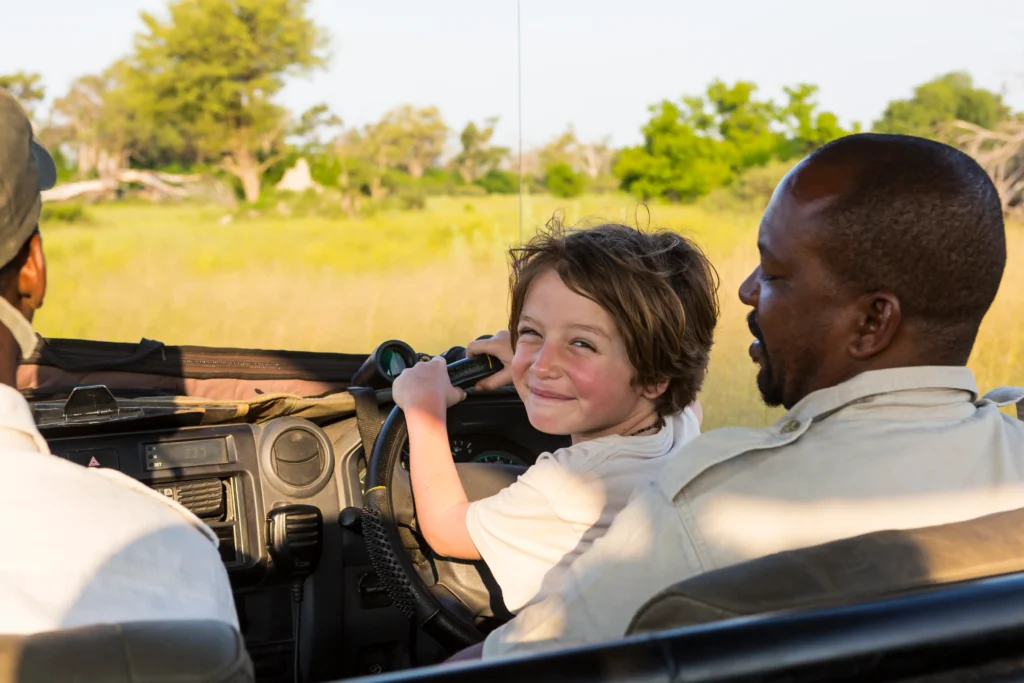
The guide can make or break a family safari. A strong family guide is knowledgeable, patient, observant, adaptable, engaging, safety-conscious, good with children, an excellent storyteller, and able to explain the same animal differently to a six-year-old and a sixteen-year-old.
Questions to Ask Before Booking a Camp
- Does the camp accept children of my child’s age?
- What is the minimum age, exactly?
- Are there family rooms, or can children share with parents?
- Are there private houses available?
- Is a private vehicle available, and at what cost?
- Are there structured children’s activities?
- Are walking or other activities age-restricted separately from the general policy?
- Can meals be adjusted for children or dietary needs?
- Is there a swimming pool?
- Is the camp fenced, or can wildlife move through freely?
- What happens after dark — are there escort rules for children?
- How far is the nearest airstrip, and how long is the transfer?
- Is there medical support nearby?
- What happens if a child becomes tired or upset mid-drive?
Family Safari Booking Checklist
- Children’s ages confirmed for every camp
- Passport validity for the full trip
- Kenya travel authorisation requirements checked
- Travel insurance in place, including medical evacuation
- Medical and travel-health advice sought in advance
- Accommodation configuration confirmed
- Child policy and minimum age restrictions confirmed per camp
- Private vehicle arranged, if chosen
- Game-drive schedule understood
- Domestic flights and road transfers booked
- Park and conservancy fees budgeted
- Meal arrangements and dietary requirements communicated
- Swimming facilities and children’s activities confirmed
- Family packing list prepared
- Beach extension arranged, if included
- Emergency and medical arrangements confirmed
Family Safari Safety & Health
Built on preparation, professional guiding and the right accommodation choice
Wildlife Safety
Children should always follow their guide’s instructions, and wild animals should never be approached independently. Camps have their own procedures for movement around the property and interaction with wildlife — follow them exactly.
Vehicle Safety
A professional safari vehicle and experienced guide matter. Children should remain seated as instructed and follow the guide’s directions during any wildlife sighting.
Camp Safety
Some camps are unfenced, with wildlife able to move freely through the camp area; others are more controlled. Choose accommodation according to your children’s ages and your family’s comfort level with this difference.
Health & Medical Planning
Seek current advice from a qualified travel-health professional before travelling — routine vaccinations, destination-specific advice, malaria prevention, travel insurance, medical evacuation cover, prescription medication, sun protection and hydration all need planning, since requirements can change year to year.
What Should Children Pack for a Kenya Safari?
A practical, no-fuss packing list
- Lightweight clothing
- Warm layers for early mornings
- Comfortable closed shoes
- Sun hat
- Sunglasses
- Sunscreen
- Reusable water bottle
- Binoculars
- Camera
- Insect protection (as advised by your travel-health professional)
- Personal medication
- Small backpack
- Swimwear
- Light rain jacket (seasonal)
- Favourite book or activity
- Comfort item for younger children
See enough — but don't rush
Explore, but leave room to rest. Give children experiences, but don’t overload them. Choose exceptional camps, but choose the right ones. Spend more time in fewer places when that creates a better experience.
Frequently Asked Questions
Family safari kenya
common questions, answered directly
There's no single right age — it depends on your child and how the trip is structured. Most camps set a general minimum age of 5-8, and we generally recommend 6 and up for a first safari.
Many camps accept infants and toddlers, but long game drives, heat and malaria risk are real considerations. A private vehicle and a shorter-drive destination like Amboseli make it more manageable.
Reputable camps and guides take child safety seriously, with clear rules around tents, walking near camp and water. We brief every guide on children's ages in advance for family itineraries we design.
Most safari regions are malaria risk areas for travellers of all ages. Consult a travel health professional or paediatrician well ahead of your trip, since not every adult prevention option suits young children.
This varies by camp and conservancy, typically higher than the general camp minimum — often 12 or above. Always confirm the specific activity's age policy separately.
Amboseli is a strong starting point due to shorter game drives and easily appreciated scenery. The Masai Mara conservancies are an excellent second choice.
For any family with a child under eight, we consider a private vehicle close to essential rather than a luxury add-on.
David Sheldrick Wildlife Trust and Giraffe Centre in Nairobi, junior ranger programmes, respectful cultural visits, and shorter guided nature walks around camp.
Give them binoculars and a specific animal to spot, bring a wildlife journal, keep drives shorter for younger children, and brief your guide on their interests in advance.
Yes, this is one of our most-recommended family combinations. Four to six nights on safari followed by four to five nights at the coast gives children a genuine change of pace.
No. Children aged 9-17 typically pay half the adult non-resident park entry fee, with children 8 and under entering free at most parks and reserves.
A family suite is typically a single larger unit, while interconnecting tents are two separate tents joined by a shared door or veranda. Both work well.
Yes. JW Marriott Masai Mara Lodge, Sirai House and Hemingways Watamu all offer family-specific accommodation and activity programmes, though many other camps accommodate families well too.
Fewer, longer stays generally work better than a packed multi-camp circuit — three well-chosen stops rather than six rushed ones.
Sun protection, insect repellent suitable for children, a hat, comfortable closed shoes, layers, familiar snacks, and comfort items that ease the adjustment to new routines.
Yes. Most higher minimum ages for these activities fall in the 12+ range, often becoming the highlight of a teenager's trip.
Flying is almost always the better choice with children, cutting a five-to-six-hour road transfer to around 45 minutes by light aircraft.
We brief guides directly on children's ages and interests before your trip and select guides with a demonstrated track record with family groups.
A private vehicle means you can simply return to camp or take a break without affecting other guests.
Yes — general camp minimum ages, and separate, often higher, minimum ages for specific activities like walking safaris and night drives.
Yes, multi-generational safaris are common and work well, particularly with a private vehicle allowing pace and activity choices to suit all ages.
Manageable with a private vehicle so pace can flex, a camp offering both junior ranger activities and walking safaris or horseback riding, and a guide briefed on each child individually.
Requirements vary by age and routing; confirm with a travel health clinic or paediatrician at least six to eight weeks before travel.
Yes, a private vehicle and a camp with a strong family track record make the biggest practical difference.
Build in a gentle first day or two in Nairobi to adjust before heading to a hotter, more remote camp.
Most family-suited camps can accommodate common dietary needs on request, given advance notice.
Most camps charge roughly 50% of the adult rate for ages 6-15, with younger children often free or heavily discounted.
Practical details matter more than the label — confirmed minimum ages, family suite availability, and a private vehicle.
More than for an adults-only trip; a pool break or unstructured afternoon keeps the trip feeling like a holiday, particularly for children under ten.
Reputable camps have basic first-aid capability and evacuation protocols; confirm travel insurance covers medical evacuation for the whole family.
Often, yes — exclusive-use accommodation, dedicated staff, a private guide and vehicle, and complete control over the daily rhythm, particularly valuable for multigenerational groups.
Yes, and Kenya works exceptionally well for this. Private dining, a bush breakfast, sundowners, photography and a celebration dinner can all be arranged, subject to camp availability and local conditions.
Roughly July to October, though river crossings are a natural event and can't be guaranteed on any specific day — the Mara offers excellent wildlife viewing well beyond the migration itself.
Not necessarily avoid, but plan well in advance if travelling during Easter, July/August, October half-term, Christmas or New Year, since the best family suites and private-use properties book out early.
Not automatically — the same criteria (age policy, room configuration, activity restrictions, private vehicle) need checking regardless of how a camp markets itself to other traveller types.
Value focuses on fewer destinations and efficient routing; luxury adds premium camps, private vehicles and domestic flights; ultra-luxury adds private-use properties, dedicated staff and highly personalised experiences.
Tell us your children's ages, interests, and available dates, and we'll recommend the right destinations, camps and pace, then return a private, itemised itinerary within 12 hours.